BUSINESS
Boeing to Cut 5% of Commercial Airplanes Workforce, Eliminating 2,500 Roles Amid Extended Production Delays
MyDigiFolio Editors
3 min read
BUSINESS
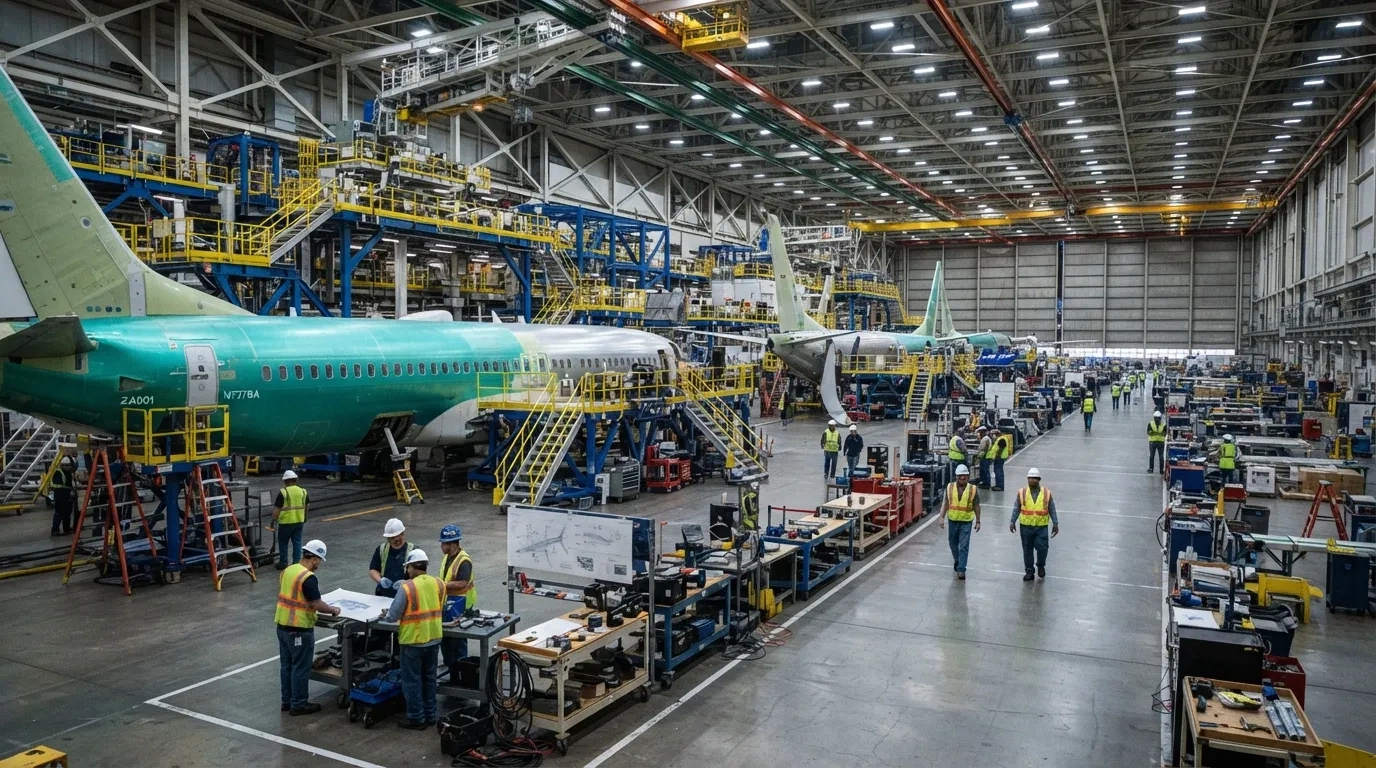
Boeing plans to cut roughly 5% of its Commercial Airplanes division—eliminating around 2,500 positions—after resetting production ramp-up schedules to allow factories and tier-one supply chains time to stabilize. According to an internal memo from Commercial Airplanes Chief Stephanie Pope, lowering assembly output has left the unit overstaffed. With monthly 737 production goals pushed into early 2027 and annual $10 billion free cash flow targets deferred to 2029, the layoffs mark Boeing’s first major workforce contraction since shedding 17,000 jobs in 2024.
Aerospace giant Boeing is preparing to reduce its Commercial Airplanes division by approximately 5%, impacting an estimated 2,500 employees across its manufacturing and engineering footprint.
The decision was communicated in an internal memo on Monday by Boeing Commercial Airplanes Chief Stephanie Pope, who detailed that the company must slow the velocity of its factory ramp-up to allow internal assembly plants and key component suppliers time to resolve persistent quality and operational bottlenecks. The headcount reductions will be executed through a combination of natural attrition and involuntary layoffs, with formal 60-day Worker Adjustment and Retraining Notification (WARN) notices scheduled to go out to staff starting in December.
The Overstaffing Paradox: Pacing Factory Output The commercial division, headquartered in Seattle, employed 50,494 workers at the end of December 2025. The recalibration reflects an operational mismatch created when factory output targets are trimmed while staffing levels reflect previous, more aggressive expansion goals:
Output vs. Headcount: Pope explained directly to employees that lowering aircraft delivery projections leaves the company structurally overstaffed across assembly pipelines.
Disciplined Ramp-Up: Speaking during Boeing's third-quarter earnings call, Chief Executive Officer Kelly Ortberg reiterated that the planemaker will enforce manufacturing discipline over raw speed, refusing to push factory lines past verified supplier capabilities.
"As shared in our third-quarter earnings, we need to reset the pace of our production rate ramps to provide our factories and supply chain partners additional time to achieve stability. Adjusting our production schedules and reducing aircraft output puts us in an overstaffed position." — Stephanie Pope, Chief Executive Officer, Boeing Commercial Airplanes
Pushed-Back Timelines: 737, 787, and Free Cash FlowThe downsizing coincides with repeated timeline deferrals across Boeing’s flagship aircraft programs:737 Narrowbody Pace: Boeing has officially abandoned its target of reaching a production cadence of 47 narrowbody jets per month by summer 2026, pushing the milestone into early 2027. An eventual increase to 52 per month is now delayed until the second half of 2027.
Widebody Strains: The company continues to face manufacturing headwinds in accelerating 787 Dreamliner assembly from eight to 10 aircraft per month, alongside recurring delays across the 767 and 777 programs.
Cash Flow Recovery Delayed: Boeing now forecasts reaching $10 billion in annual free cash flow in 2029—a full year behind previous financial guidance and Wall Street consensus expectations.
Stabilizing from the 2024 Crisis The upcoming retrenchment represents Boeing's first major workforce cut since late 2024, when the aerospace manufacturer eliminated 17,000 positions under newly appointed CEO Kelly Ortberg. That contraction followed a crippling month-long machinists' strike, steep operational losses, and intensive regulatory oversight stemming from the mid-air door plug blowout on an Alaska Airlines 737 MAX 9.
By moderating delivery schedules and cutting 2,500 commercial roles, Boeing leadership is seeking to lower monthly cash burn and insulate factory floors from quality defects, prioritizing manufacturing predictability over aggressive short-term delivery quotas.

BigGo Finance · 1 day ago
Global technology layoffs have surpassed 200,000 workers in 2026—already outpacing the 245,000 total recorded across all of 2025, according...

Staffing Industry Analysts · 4 days ago
Global freelance marketplace Upwork has expanded its corporate restructuring plan to eliminate roughly 37% of its total workforce—up sharply...

CNET · 5 days ago
With over 200,000 technology workers laid off or offered voluntary buyouts in 2026—spanning profitable giants like Microsoft, Oracle, Amazon...
From MyDigiFolio
One profile. Resume, vCard, portfolio, and email signatures — all generated in 3 minutes.
Build your page — freeWe use essential cookies for login and preferences, and optional cookies for analytics. Privacy policy.