AI & TECH
Samsung Posts Historic $80.5 Billion Quarterly Operating Profit on AI Memory Surge as Shares Dip on Capex Doubts
MyDigiFolio Editors
3 min read
AI & TECH
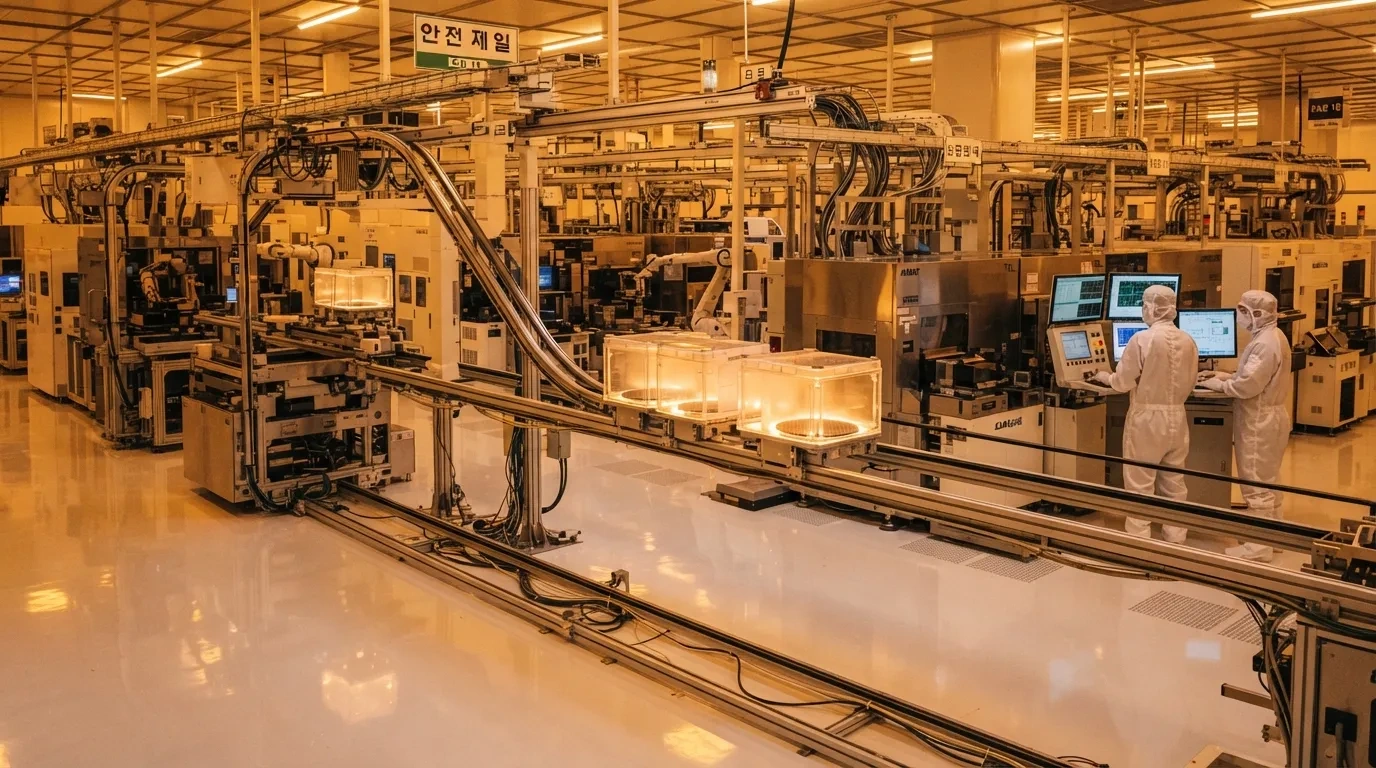
Samsung Electronics became the first tech firm to cross 100 trillion won in quarterly operating profit, posting 107.4 trillion won ($80.5 billion)—a 780% jump driven by severe global shortages of High Bandwidth Memory for AI data centers. Despite the historic haul and a massive 110 trillion won shareholder return plan, Samsung shares fell over 5% on semiconductor division profit misses and investor anxiety over whether hyperscaler AI infrastructure spending has neared peak earnings.
South Korean semiconductor giant Samsung Electronics has delivered unprecedented financial results, posting a record quarterly operating profit of 107.4 trillion won ($80.5 billion) for the July–September period—a staggering 780% surge year-on-year.
The milestone marks the first time in history that any global technology company has crossed the 100 trillion won quarterly operating profit threshold. Net profit climbed over 510% to 75.1 trillion won, while group revenues touched 195.3 trillion won, propelled by unrelenting hyperscale demand for high-performance memory powering artificial intelligence server infrastructure.
The Great HBM Shortage and Server Pricing Power The earnings explosion reflects an acute global supply deficit in cutting-edge memory silicon:
HBM Dominance: High Bandwidth Memory (HBM)—the specialized silicon stacked adjacent to GPUs to feed data into frontier model clusters—commanded record pricing power amid severe foundry capacity constraints.
Consumer Spillover: As memory giants shifted silicon wafer allocations toward high-margin AI modules, supplies of conventional DRAM and NAND for laptops and smartphones tightened, driving up wholesale market prices across consumer electronics.
The Asymmetric AI Trade: As Pepperstone research strategist Dilin Wu observed, semiconductor foundries are reaping immediate, guaranteed cash flows from the AI buildout, while the hyperscalers and downstream software vendors buying the chips remain under pressure to prove tangible return on investment.
"Chipmakers are benefiting directly from the AI investment boom, while the companies buying their chips are still trying to prove they can earn a decent return on all that spending." — Dilin Wu, Research Strategist, Pepperstone
Wall Street Disconnect: Why Shares Fell 5% Despite the astronomical numbers, Samsung's stock tumbled over 5% in morning trading in Seoul, underscoring a deep divide between current cash generation and forward market expectations:
Division Expectations Miss: Operating income from the core semiconductor division came in below heightened analyst forecasts, triggering immediate profit-taking.
Peak Cycle Anxiety: Having tumbled from June record highs alongside broader semiconductor equities, investors continue to question whether enterprise infrastructure spending is entering its late-stage cycle.
Supply Roadblocks Ahead: Chief Financial Officer Park Soon-cheol cautioned that while AI infrastructure and agentic deployments will drive "unprecedented demand growth in 2027," physical cleanroom and fabrication constraints will make it difficult to expand short-term output.
110 Trillion Won Shareholder Capital Return To counter valuation discounts and reassure institutional investors, Samsung outlined an aggressive capital return strategy:
Record Payouts: Samsung committed to returning up to 110 trillion won to shareholders this year, including 30 trillion won in direct cash dividends.
Following Industry Moves: The package arrives alongside domestic peer SK hynix’s announcement of a 60 trillion won return program, following its own 40 trillion won distribution.
Addressing Undervaluation: KB Securities noted that the unprecedented capital returns provide a pivotal opportunity to narrow the valuation discount on South Korean semiconductor heavyweights, directly linking historic operational windfalls to shareholder yields.
People Matters · 11 hours ago
Nvidia Chairman Harvey Jones has firmly ruled out reinstating co-founder Jensen Huang as chief executive, hours after Huang publicly apologi...

People Matters · 11 hours ago
The US Cybersecurity and Infrastructure Security Agency (CISA), alongside the Canadian Centre for Cyber Security, has issued an urgent advis...
The Indian Express · 2 days ago
Nvidia’s board has reportedly approached Arm Holdings CEO Rene Haas as a prospective replacement for longtime chief Jensen Huang, who steppe...
From MyDigiFolio
One profile. Resume, vCard, portfolio, and email signatures — all generated in 3 minutes.
Build your page — freeWe use essential cookies for login and preferences, and optional cookies for analytics. Privacy policy.